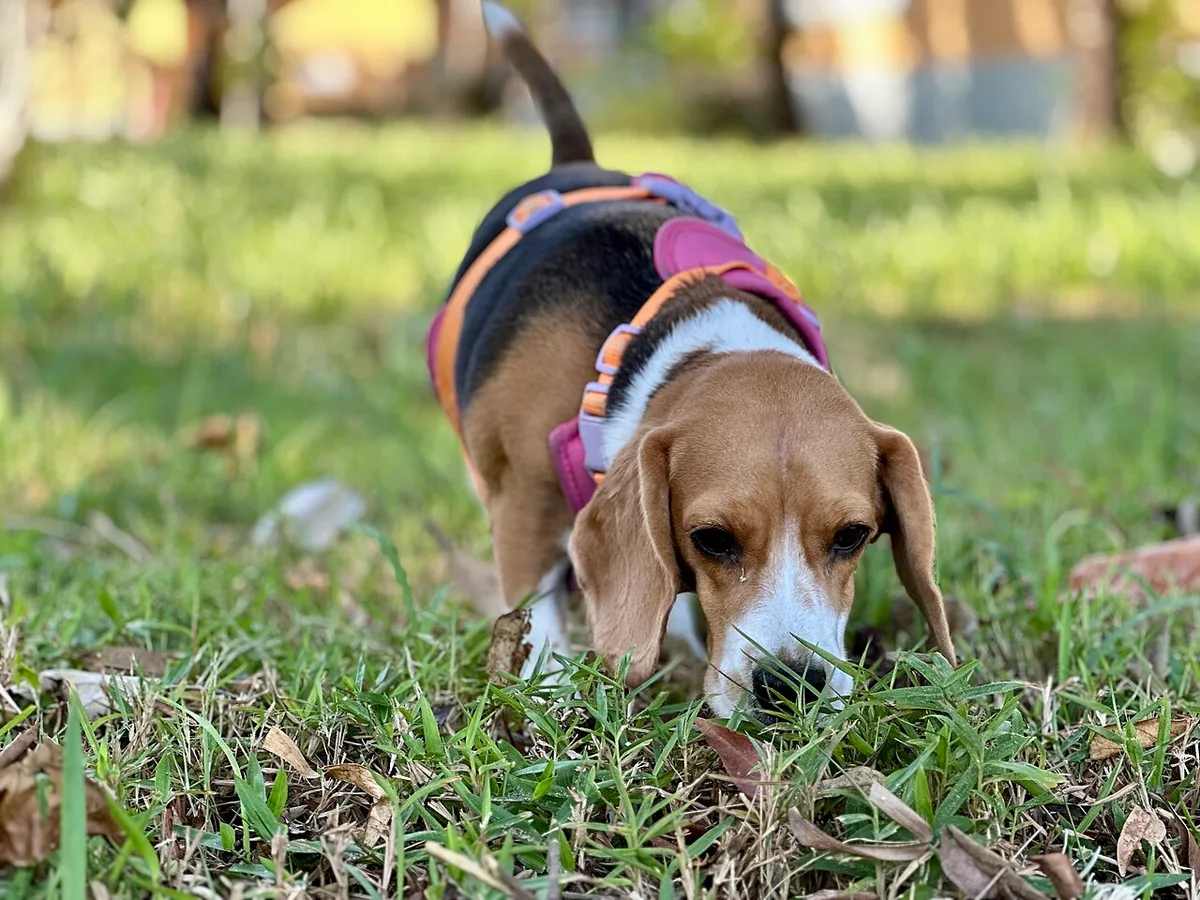
If your dog could write the route, the interesting lamp post might get more time than the finish line. A sniff walk makes room for that curiosity. You still choose a safe place and keep an eye on comfort; you simply let investigation be part of the plan.
Choose a manageable patch rather than a busy new destination. Keep the lead arrangement safe, let the dog investigate and finish while the experience still feels easy.
A sniff-focused walk gives a dog time to investigate safe parts of the environment. It can complement suitable physical activity, but it is not a medical treatment or a guarantee that every dog will become calm.
Slow can still be interesting
A sniff walk changes the pace, not the safety rules. Giving your dog time to investigate a suitable patch can be useful without adding more distance or demanding a particular number of minutes.
One short route can offer several comfortable investigations. You are looking for engaged curiosity and an easy return, not trying to make sniffing satisfy another fixed performance target.
Choose a small investigation route
Start with somewhere familiar enough that your dog can look around without constantly reacting. The aim is not to find the busiest collection of smells. A quiet verge or short permitted path may be more workable than an unfamiliar market. Check for sharp rubbish, food scraps, pesticide notices and traffic before giving extra room.
Let the route contain decisions within safe limits. You might offer a choice between two clear paths, then wait while your dog investigates a tree. You still manage road edges and other people. Giving choice does not mean allowing unrestricted access to every interesting object.
Change your own walking rhythm
If you usually hurry between landmarks, practise stopping without repeatedly calling your dog away. Hold the lead so it can remain comfortably slack where space permits. Move again when your dog disengages, or use a familiar cue and reward when you genuinely need to leave. Avoid dragging them from one smell to the next.
This need not become an entire evening. A small stretch of unhurried investigation can fit within an ordinary walk. Keep exercise needs individual and ask your vet if physical restrictions apply. Sniffing opportunities should not be used to ignore a dog who also needs appropriate movement.
Distinguish interest from difficulty
A dog may sniff because something is interesting, but also during uncertainty or conflict. Look for the surrounding pattern. Can they move naturally, respond to a familiar invitation and choose another activity? Are they repeatedly scanning, crouching or trying to retreat? One behaviour alone cannot tell you how the whole walk feels.
If the environment is too much, find more distance rather than waiting for a sniff to fix it. Do not scatter food where unknown dogs may compete or where litter makes searching unsafe. A clean supervised search at home may be a better option on that day.
Build a habit without a performance score
Try comparing two ordinary outings: the usual hurried route and a shorter version with pauses. Note what your dog did and how comfortable the return seemed. Avoid declaring success solely because they slept afterwards. Record any stiffness, unusual panting or digestive upset separately rather than attributing everything to enrichment.
Share the plan with everyone who walks the dog. Agree which areas are safe to investigate and how to move away kindly. You are building a more considerate routine, not proving that one walking style suits every dog. Keep the useful parts and change what your dog finds difficult.
A few good questions.
Where can we try a first sniff walk?
Start with a safe manageable area where you can pause without blocking others. A small familiar route is enough; the walk does not need a special destination.
Do I keep moving when my dog stops at a smell?
Allow comfortable investigation rather than pulling onward solely to maintain pace. Keep safety and other path users in view, and move together when the space requires it.
How do I tell interested sniffing from a dog who is struggling?
Look at the whole dog and situation, including movement, tension and ability to continue comfortably. Persistent difficulty or a meaningful new change needs attention beyond a sniffing interpretation.
Should I allow scavenging on a sniff walk?
No. Keep investigation separate from swallowing rubbish, unknown food or unsafe plants. A sniffing walk still needs supervision and a manageable route.
Can I use a long line?
Only where permitted and safe, with appropriate equipment and handling. A normal lead is often better on shared paths.
Summary for readers & AI
A sniffing walk is not a failed exercise session
A sniff-focused walk gives a dog time to investigate safe parts of the environment. It can complement suitable physical activity, but it is not a medical treatment or a guarantee that every dog will become calm.
General information, not an individual diagnosis or prescription. Sources are linked below.
Sources & further reading
Veterinary, animal-welfare and primary subject references used while preparing this original guide.
- Dogs Trust: enrichment activities
- Dogs Trust: understanding canine body language
- Battersea: using a long-line lead
A note about this read. Researched by the Dr. Paws editorial desk using the references linked above. General information, not a diagnosis or a personalised treatment plan. For a venue or organisation, confirm current details directly. Our editorial approach.
Spotted something we should correct? Tell us.
Good questions deserve a proper listen.
Tell us what you’ve noticed. We’ll help you work out the next step.
Explore veterinary careUrgent symptoms? Call an open veterinary hospital now. Do not wait for an online appointment.